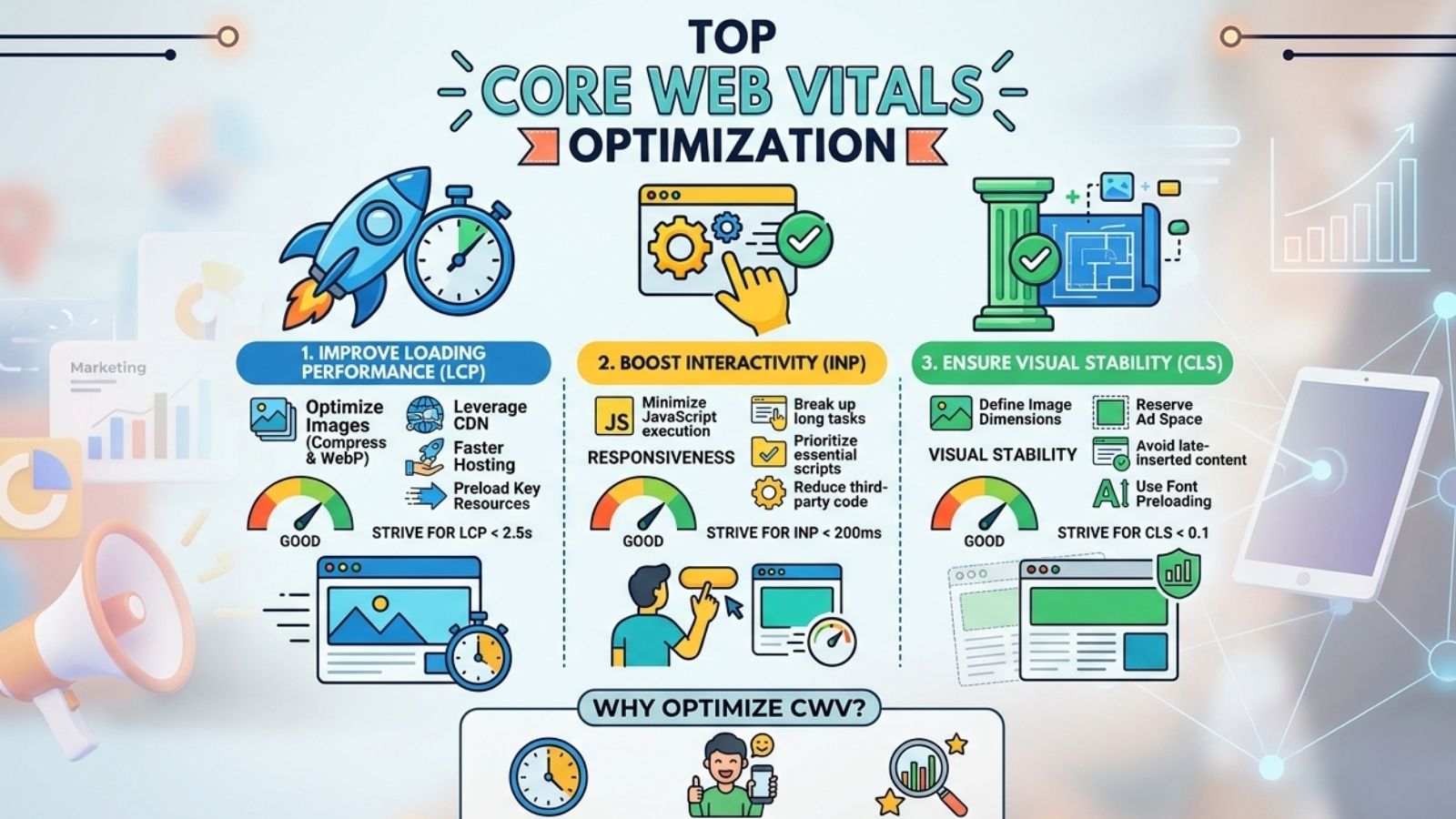
Welcome to AdsCollab (adscollab.com), your collaborative advertising platform that connects publishers with premium demand, header bidding integrations, and performance-focused tools to maximize ad revenue while maintaining exceptional user experience. In 2026, fast-loading, responsive sites not only improve engagement and conversions but also support higher ad yields-making Core Web Vitals optimization 2026 essential for publishers balancing monetization and SEO success. This guide explores the latest metrics, updates, and actionable strategies to excel in the current landscape.
Core Web Vitals (CWV) remain Google's key real-user experience signals, influencing rankings, user retention, and indirectly ad performance. By 2026, refinements emphasize mobile-first, context-aware thresholds, and comprehensive interactivity measurement, with Core Web Vitals optimization 2026 focusing on passing thresholds consistently across devices and conditions for competitive edges in search and programmatic ecosystems.
What Is Core Web Vitals Optimization 2026?
Core Web Vitals (CWV) are a set of user-focused performance metrics introduced by Google to evaluate how real visitors actually experience a website. Instead of relying only on technical lab tests, CWV uses real-user data (field data) collected from the Chrome User Experience Report (CrUX), making it a much more accurate reflection of real-world performance.
In Core Web Vitals optimization 2026, these metrics have evolved beyond simple speed checks-they now represent a complete framework for measuring loading performance, interactivity, and visual stability across devices, networks, and user conditions.
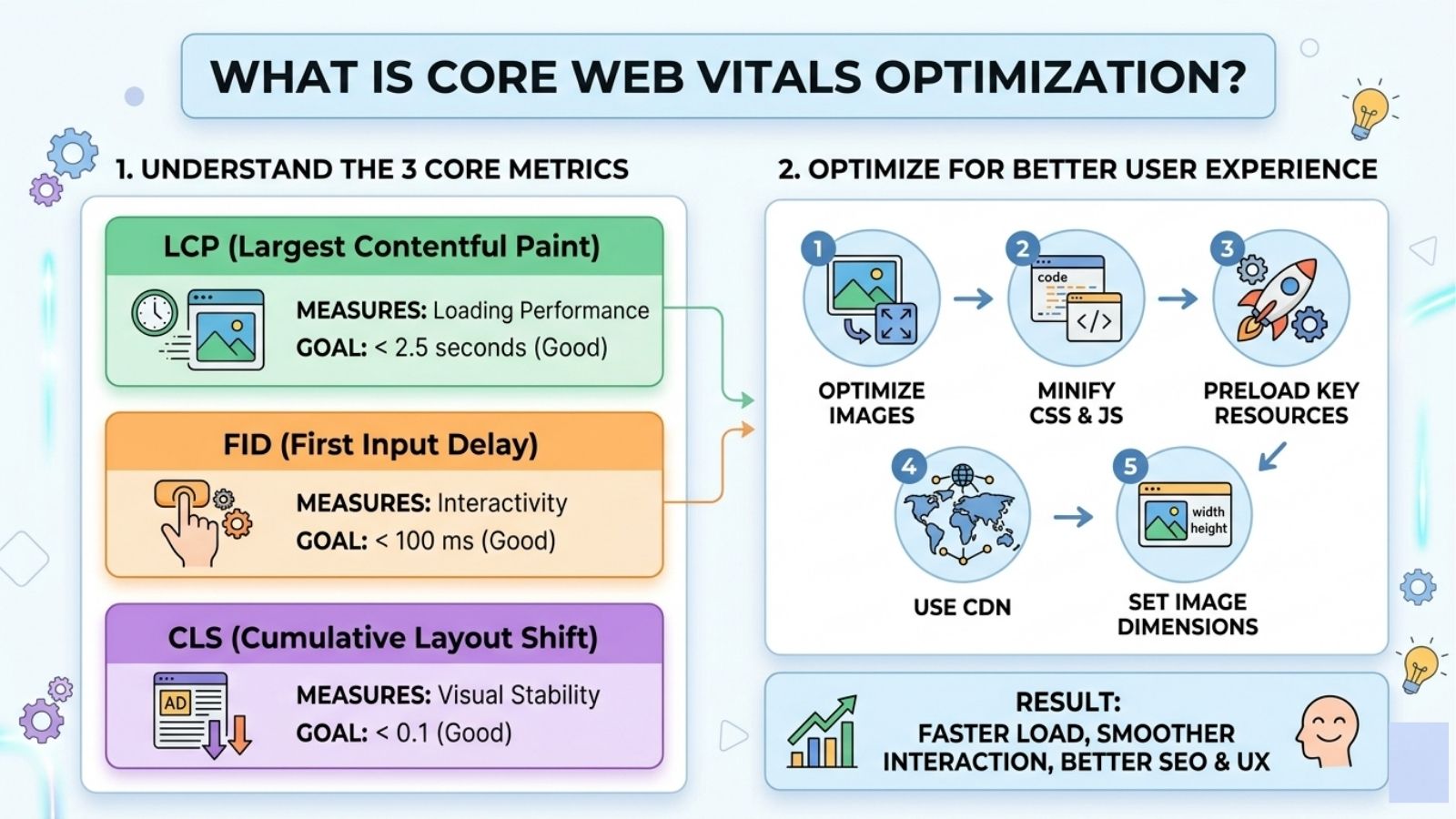
The Three Core Metrics
- Largest Contentful Paint (LCP):
Measures how quickly the main content of a page becomes visible to users. This is typically the largest image, video, or text block in the viewport. A fast LCP ensures users feel the page loads quickly and smoothly.
👉 Ideal target: under 2.5 seconds (top sites aim for <2s) - Interaction to Next Paint (INP):
Evaluates how responsive your page is when users interact with it-clicking buttons, tapping menus, or typing in forms. INP replaces the older FID metric and measures responsiveness throughout the entire session, not just the first interaction.
👉 Ideal target: under 200 milliseconds - Cumulative Layout Shift (CLS):
Tracks unexpected layout movements during page load. For example, when ads or images load late and push content around, it creates a poor experience.
👉 Ideal target: below 0.1
What Makes Core Web Vitals Optimization 2026 Different?
In 2026, Core Web Vitals optimization is no longer just about passing minimum thresholds-it’s about consistently delivering fast, stable, and responsive experiences across all real-world scenarios.
Key shifts include:
- Mobile-First Real-User Data:
Performance is now evaluated primarily on mobile devices using real user conditions such as slower networks and lower-end hardware. Desktop optimization alone is no longer enough. - AI-Assisted Performance Tuning:
Modern tools use artificial intelligence to automatically detect bottlenecks, suggest improvements, and even apply optimizations like dynamic image compression, script prioritization, and predictive preloading. - Context-Aware Benchmarks:
Google increasingly considers context such as device type, connection speed, and user environment. However, top-performing websites still aim for aggressive targets to stay competitive. - Full User Journey Measurement:
Instead of focusing only on page load, CWV in 2026 evaluates the entire lifecycle of user interaction, ensuring consistent performance from first paint to final interaction.
Understanding Core Web Vitals in 2026
Core Web Vitals consist of three primary metrics that quantify loading, interactivity, and visual stability based on real-user field data from the Chrome User Experience Report (CrUX). The metrics are:
Largest Contentful Paint (LCP) measures perceived loading speed by tracking when the largest visible content element (image, video block, or text block) renders, with a good threshold under 2.5 seconds.
Interaction to Next Paint (INP) evaluates responsiveness across the entire page lifecycle, measuring the latency of all user interactions (clicks, taps, key presses) and aiming for under 200 milliseconds to feel snappy.
Cumulative Layout Shift (CLS) quantifies unexpected layout movements during loading, targeting a score under 0.1 to prevent frustrating shifts like ads or images pushing content.
In 2026, these form the baseline for page experience signals. Google has refined measurements with more emphasis on real-world data over lab simulations, mobile performance, and session-based evaluation for dynamic sites. Passing CWV (good scores on 75%+ of pageviews) acts as a tiebreaker in rankings and supports better ad viewability and fill rates.

Key Updates and Changes to Core Web Vitals in 2026
While the core trio (LCP, INP, CLS) persists, 2026 brings evolutionary enhancements often referred to in industry discussions as CWV refinements or contextual adjustments. Thresholds remain stable but incorporate device capability, network normalization, and industry-specific baselines for fairer assessment.
INP fully supplants the older First Input Delay (FID), providing a holistic view of interactivity beyond just the first action. This shift rewards sites that maintain low latency even during heavy JavaScript execution or third-party loads.
Mobile-first emphasis intensifies, with stricter scrutiny on iOS and Android field data. Context-aware scoring normalizes for slow networks or lower-end devices, but top performers still target aggressive benchmarks like LCP under 2 seconds and INP under 150ms for premium ranking signals.
These updates align with broader trends like AI-driven search and zero-click experiences, where fast, stable pages retain users longer and improve monetization through higher engagement.
Why Core Web Vitals Optimization Matters for Publishers in 2026
Poor CWV directly hurts SEO visibility, bounce rates, and ad performance. Sites failing thresholds see reduced organic traffic, lower ad viewability (impacting CPMs), and higher abandonment-critical for programmatic setups relying on user sessions.
In 2026, optimized CWV correlates with 10-20% better rankings in competitive niches, higher conversion rates, and improved header bidding outcomes as faster pages support more demand partners without latency penalties. Publishers using platforms like AdsCollab benefit from smoother integrations when sites load quickly and remain stable.
Comparison Table: CWV Optimization 2026 vs Traditional Optimization
| Feature | Traditional Optimization | Core Web Vitals Optimization 2026 |
|---|---|---|
| Focus | Page load time only | Full user experience |
| Metrics | PageSpeed score | LCP, INP, CLS |
| Data Type | Lab data | Real-user data (CrUX) |
| Approach | Basic compression | AI + predictive optimization |
| UX Impact | Limited | Direct ranking + engagement impact |
| Mobile Priority | Secondary | Primary |
| Ad Performance | Indirect | Strong direct influence |
Mastering Interaction to Next Paint (INP) in 2026
INP challenges arise from heavy main-thread work. Break up long tasks with code splitting, web workers for background processing, and async operations.
Minimize third-party scripts-defer non-essential trackers and use lightweight alternatives. Optimize event handlers by debouncing inputs and avoiding layout thrashing.
Leverage browser optimizations like passive listeners for touch/scroll events. For complex interactions, use CSS animations over JavaScript where possible to offload the main thread.
Monitor with tools identifying slow elements and apply targeted fixes like reducing DOM size or batching updates.
Preventing Cumulative Layout Shift (CLS) in 2026
CLS stems from unsized media and dynamic inserts. Always define width/height attributes on images and videos, or use aspect-ratio CSS for reserves.
Reserve space for ads, embeds, and late-loading content with containers or skeletons. Avoid injecting content above existing elements without animation.
Use font-display: swap for web fonts to prevent invisible text shifts, and preload critical fonts. Stabilize injects from third-parties by wrapping in fixed-size divs.
Advanced Tools and Monitoring for Core Web Vitals in 2026
Track performance with Google Search Console's Core Web Vitals report for field data, PageSpeed Insights for diagnostics, and CrUX Dashboard for trends.
Advanced options include Web Vitals Chrome extension for real-time debugging, Lighthouse in DevTools for audits, and third-party platforms offering AI-powered insights, regression alerts, and programmatic fixes.
For publishers, integrate CWV monitoring into ad tech stacks to correlate speed with revenue metrics.
Common Mistakes to Avoid in Core Web Vitals Optimization 2026
Over-relying on lab data ignores real-user variability-always validating with field metrics. Neglecting mobile performance leads to skewed scores. Adding heavy third-party scripts post-optimization causes regressions.
Failing to set performance budgets for images, JS bundles, or third-parties results in creeping slowdowns. Ignoring ongoing maintenance misses gradual degradations from new features.
Core Web Vitals optimization 2026 is best for:
- Content-heavy blogs and publishers
- Affiliate marketing websites
- News and media platforms
- High-traffic SEO-driven sites
- Websites using header bidding monetization
👉 Need help optimizing performance + revenue? get expert optimization support now!
Why Core Web Vitals Optimization 2026 Matters
- Improves SEO rankings and visibility
- Reduces bounce rates
- Increases session duration
- Boosts ad viewability and CPM
👉 Learn more about performance-driven monetization on AdsCollab Blog
FAQ: Core Web Vitals Optimization 2026
1. What is the ideal LCP in 2026?
Under 2.5 seconds, ideally below 2 seconds.
2. Why is INP replacing FID?
INP measures full interaction lifecycle, not just the first input.
3. Does CWV directly affect rankings?
It’s a ranking signal and a strong tiebreaker factor.
4. Can improving CWV increase revenue?
Yes-better UX leads to higher engagement and ad performance.
5. How often should I audit CWV?
At least monthly, or after major updates.
How AdsCollab Supports Core Web Vitals-Optimized Sites
AdsCollab (adscollab.com) thrives on fast, stable environments. Our lightweight integrations, header bidding wrappers, and demand optimizations minimize impact on CWV while maximizing revenue. Pair your optimized site with our tools for seamless performance and monetization synergy.
Conclusion
Core Web Vitals optimization 2026 is no longer optional-it's foundational for SEO visibility, user satisfaction, and ad revenue in a mobile-first, AI-influenced web. By aggressively tackling LCP, INP, and CLS with modern techniques, publishers secure better rankings, lower bounce rates, and stronger programmatic results. Start auditing today, implement fixes iteratively, and monitor continuously to stay ahead. Visit AdsCollab.com to explore how our platform complements high-performance sites for maximum earnings

