If you're a publisher looking to monetize your website's search functionality, Google AdSense for Search (AFS) is one of the most powerful tools in the Google ecosystem. In 2026, as AI search reshapes traffic patterns and traditional AdSense faces growing competition, understanding AFS can help you add a high-intent revenue stream without disrupting user experience. Welcome to AdsCollab – your partner for collaborative advertising solutions that go beyond basic AdSense. Whether you're exploring Google AFS or premium alternatives, we help publishers maximize RPM through header bidding, premium demand, and smart optimizations.
Understanding Google AdSense for Search (AFS)
Google AFS, or AdSense for Search, allows website and app owners to integrate Google-powered search boxes and display targeted ads alongside the search results on their own sites. Unlike standard AdSense for Content (which places ads on your articles), AFS monetizes the search experience itself. When users search on your site (e.g., for product comparisons, guides, or niche information), AFS serves relevant Google Search and Shopping ads. You earn revenue when users click those ads – tapping into Google's vast advertiser network and search intelligence.
Key Features of Google AFS in 2026
In 2026, Google AdSense for Search (AFS) continues to evolve as a robust monetization solution that leverages Google's advanced search and advertising technology. By embedding a powerful, branded search experience directly on your website, AFS not only improves user engagement but also unlocks additional revenue from high-intent queries. Below are the key features of Google AFS in 2026 that make it a valuable addition — or complement — to your overall ad strategy, especially when combined with premium networks and AI-driven optimizations.
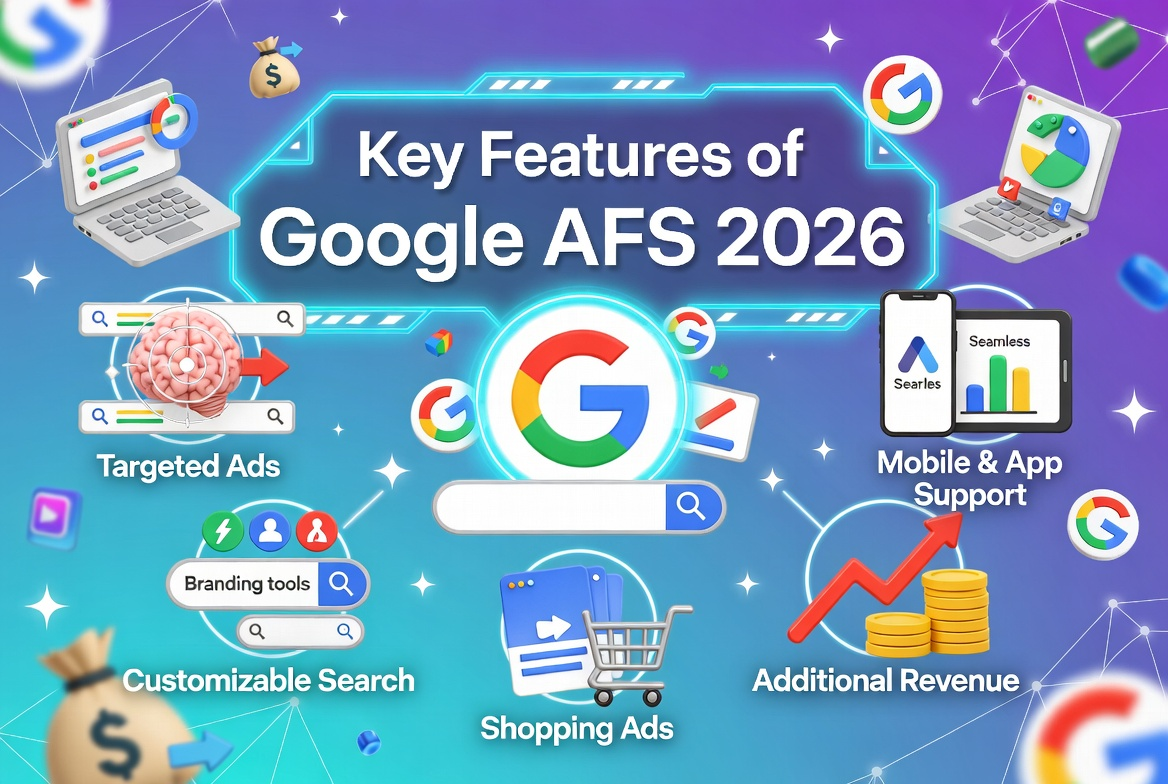
- Targeted Ads
Ads match user queries precisely, similar to Google Search results. In 2026, Google AFS utilizes sophisticated AI and machine learning to deliver highly relevant advertisements that align exactly with the user's search intent on your site. This precision targeting draws from Google's vast advertiser pool, ensuring that results include contextual text ads, product listings, and Shopping ads that feel native to the search experience. Publishers in competitive niches like finance, insurance, and legal services particularly benefit, as these queries often trigger higher bids from advertisers, resulting in stronger CPMs and click-through rates compared to generic display ads.
- Customizable Search
Style the search box and results page to match your site's branding. AFS offers extensive customization options, allowing you to design the search bar, result layout, color schemes, fonts, and even ad styling to seamlessly blend with your website’s aesthetic. This ensures a consistent user experience without disrupting design flow. In 2026, enhanced styling tools support responsive designs and dark/light mode compatibility, helping maintain strong Core Web Vitals while reinforcing your brand identity — crucial for building authority in Generative Engine Optimization (GEO) and retaining visitors longer on-site.
- Shopping Ads Integration
One of the standout enhancements in Google AFS for 2026 is deeper integration with Google Shopping, enabling rich visual product cards, price comparisons, and carousel formats directly in search results. This feature excels for review sites, affiliate blogs, or e-commerce content hubs, where users searching for “best [product] 2026” see tangible product imagery and offers. The result is higher engagement, improved conversion potential, and the ability to layer affiliate revenue alongside ad clicks, significantly boosting overall RPM in commercial niches.
- Mobile & App Support
With mobile traffic dominating in 2026, AFS provides native, frictionless support for mobile websites, PWAs, and apps. The search implementation is fully responsive, fast-loading, and optimized for touch interactions, ensuring ads display correctly across devices. This feature helps publishers capture revenue from on-the-go users while maintaining compliance with privacy standards and speed requirements, making it easier to compete in an AI-first search landscape where users expect instant, mobile-friendly results.
- Additional Revenue Layer
Google AFS acts as a powerful supplementary income stream that works harmoniously with existing AdSense for Content setups or third-party platforms such as Media.net (contextual ads), Ezoic (AI optimization), and header bidding solutions. This diversification reduces dependency on a single network, mitigates risks from policy changes, and allows publishers to test and scale across multiple demand sources. Many successful sites in 2026 combine AFS with premium networks like Mediavine or Raptive to achieve substantial revenue lifts while maintaining excellent user experience.
AFS is especially effective in high-CPM niches such as finance, insurance, legal, and B2B SaaS, where search intent is strong and advertisers bid aggressively.
How Google AFS Works for Publishers
Understanding the mechanics of Google AdSense for Search (AFS) is essential for publishers who want to maximize on-site search monetization in 2026. The process is straightforward yet powerful, leveraging Google’s real-time advertising auction system to turn your website’s internal search into a revenue-generating feature. Below is a step-by-step breakdown of how Google AFS works for publishers, from implementation to earnings.
Step 1: Implement the Search Box
The first step involves integrating the AFS code snippet into your website. After gaining approval for AdSense for Search in your Google AdSense account, you generate a customized search box code through the AdSense dashboard. You can place this search bar in prominent locations such as the header, sidebar, or footer. In 2026, the implementation supports modern frameworks (including React, WordPress plugins, and custom HTML), with options for auto-complete suggestions and advanced styling. Proper placement and mobile optimization ensure high usage rates while maintaining fast page load times.
Step 2: Users Search
Once a visitor enters a query into your site’s AFS-powered search box, the system instantly sends the request to Google’s servers. This triggers a real-time ad auction where advertisers bid for the opportunity to appear in the results. Google’s advanced algorithms analyze the search term, user context (such as location and behavior), and page content to select the most relevant ads. This auction happens in milliseconds, ensuring a smooth experience. High-intent queries in niches like finance, insurance, or product reviews often attract intense competition, leading to higher bids and better payouts for publishers.
Step 3: Ads Display
After the auction concludes, Google delivers a combination of text ads, Shopping ads, and other formats directly on the custom search results page. These ads are clearly labeled as “Sponsored” to comply with transparency policies. Publishers can control the number of ads shown, their positioning, and overall layout to balance revenue with user experience. In 2026, enhanced AI capabilities make the ads even more contextual and visually appealing, increasing click likelihood while blending naturally with organic search results on your site.
Step 4: Earn Revenue
You earn money every time a user clicks on a sponsored ad in the AFS search results — following the proven pay-per-click (PPC) model. Earnings vary based on advertiser competition, niche, user geography (Tier-1 countries pay significantly more), and ad quality. Because AFS taps into Google’s massive Search Network, rates are often competitive, especially in high-CPM verticals. Payments are consolidated through your regular AdSense account, with detailed reporting available to track performance, clicks, and revenue per search session. Many publishers combine this with other networks for diversified, stable income.
In 2026, AFS benefits from Google’s AI advancements, delivering more relevant ads even as generative search (GEO) reduces some traditional clicks.
Pro Tip: Combine AFS with structured content (clear headings, tables, and answer-first formats) to improve both search quality on your site and overall site authority for better ad performance.
Benefits of Using Google AFS
Beyond its technical capabilities, Google AdSense for Search (AFS) delivers tangible advantages that make it a smart choice for publishers navigating the competitive 2026 monetization landscape. By turning on-site search into a revenue driver, AFS helps sites capture value from user intent while complementing broader strategies like GEO optimization and premium ad networks. Here are the key benefits of using Google AFS that can meaningfully boost your earnings and site performance.
- High-Intent Traffic Monetization
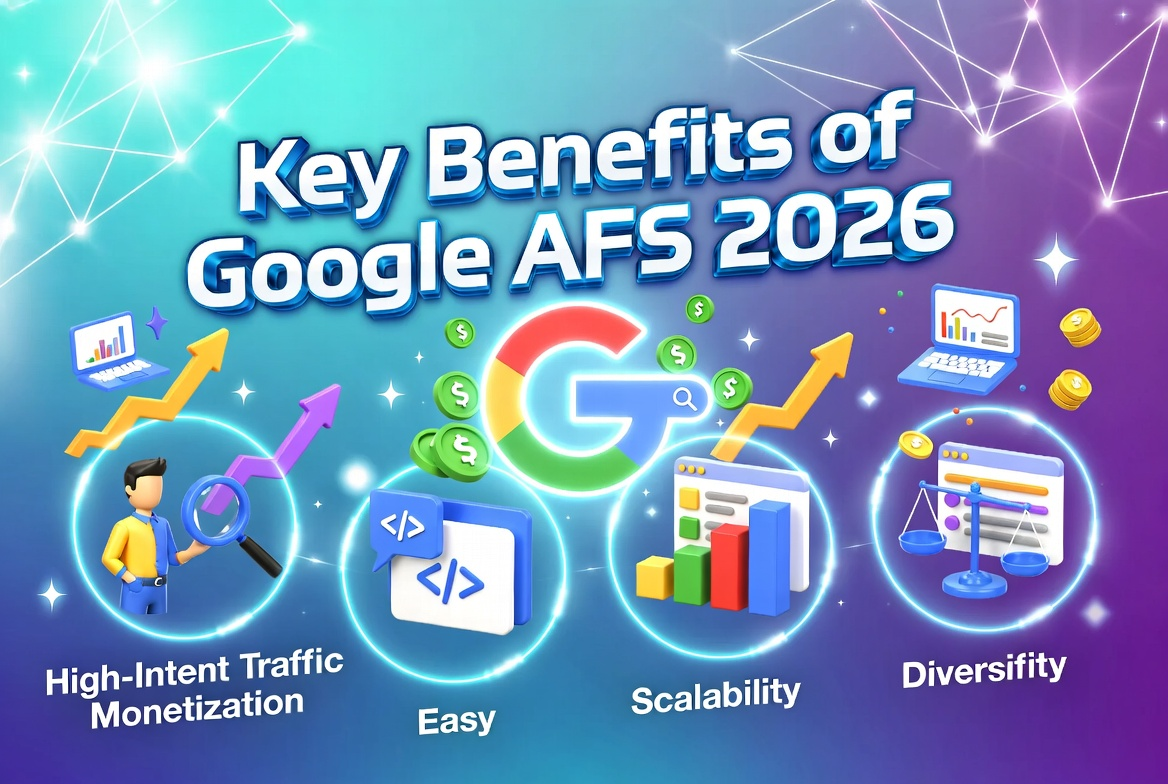
Search users on your site are actively looking for solutions – leading to stronger CPMs and click-through rates. Users who perform searches on your website are typically in a high-intent phase — they are actively seeking answers, comparisons, products, or solutions rather than casually browsing. AFS capitalizes on this by serving precisely matched ads, resulting in significantly higher click-through rates (CTR) and elevated effective CPMs compared to standard display advertising. In 2026, this is particularly powerful in high-value niches such as finance, insurance, legal services, and e-commerce reviews, where a single qualified click can generate premium revenue due to intense advertiser competition and strong commercial intent.
- Easy Integration
Works well with existing AdSense setups. One of the biggest advantages of Google AFS is its seamless compatibility with your current AdSense for Content implementation. You don’t need a separate account — everything is managed from the same dashboard, simplifying approval, tracking, and payments. Implementation typically takes just minutes using standard code snippets or popular CMS plugins. This low-friction onboarding makes AFS an accessible upgrade for both beginners and experienced publishers, allowing you to layer search monetization without overhauling your existing ad infrastructure.
- Scalability
Ideal for content-heavy sites, blogs, and forums. AFS scales effectively as your site grows. Content-rich websites, niche blogs, knowledge bases, and community forums naturally attract frequent internal searches, making AFS a perfect fit. As traffic increases, so do search volume and revenue opportunities without additional effort. In 2026, the system handles high query loads efficiently while supporting advanced features like personalized suggestions and result pagination, helping large publishers maintain performance even with thousands of daily searches.
- Diversification
Reduces reliance on display ads alone, especially useful amid AdSense policy challenges. Relying solely on traditional display ads exposes publishers to risks such as policy violations, fluctuating RPMs, and cookie deprecation. AFS provides a valuable diversification channel by monetizing search behavior separately from content ads. This reduces vulnerability to account issues or algorithm changes and creates multiple income streams. Many publishers successfully combine AFS with alternatives like Ezoic, Media.net, or header bidding solutions (Setupad, Publift) to achieve more stable and higher overall revenue while maintaining strong user experience.
Publishers in finance or insurance niches often see significant lifts by layering AFS with premium networks like Mediavine or Setupad.
Limitations and When to Consider Alternatives
Google AFS shares several constraints inherent to the broader AdSense ecosystem. First, it requires formal approval beyond a standard AdSense account — not all sites automatically qualify, especially newer or lower-traffic websites. Strict policy compliance is mandatory; violations related to content quality, ad placement, or prohibited niches can lead to account suspension or limited functionality. Additionally, revenue potential can be capped in low-competition niches or Tier-2/3 countries, where advertiser demand is weaker, resulting in lower CPMs compared to premium networks. Finally, customization, while good, is still bounded by Google’s guidelines, limiting full control over ad types and auction dynamics.
For advanced publishers aiming to scale beyond basic AFS performance, it’s often beneficial to combine AFS with more powerful solutions or transition partially/fully to specialized platforms. Header bidding implementations (such as Setupad) enable simultaneous auctions from multiple demand sources, frequently delivering 30-200% revenue lifts. AI-powered platforms like Ezoic automatically optimize layouts and tap into broader ad exchanges, while premium networks like Publift, Mediavine, or Raptive provide higher RPMs, better support, and advanced tools for high-traffic or niche-specific sites. Consider alternatives when you have consistent traffic but want greater control, higher yields in competitive niches, or reduced dependency on Google’s policies. Many successful publishers run AFS as a complementary layer alongside diversified programmatic setups for maximum stability and growth.
Here are
How to Get Started with Google AFS
Ready to turn your internal site search into a high-yielding revenue stream? Setting up Google AdSense for Search is a straightforward process, but maximizing its potential in 2026 requires a blend of technical execution and strategic content alignment. Below is a comprehensive, step-by-step breakdown of how to seamlessly integrate AFS into your website and position your platform for peak monetization.
- Ensure Active AdSense Account Standing
Your journey to monetizing your website’s internal search function begins with a foundational prerequisite: an active, fully verified Google AdSense account that strictly complies with Google’s program policies. If you are already running standard display ads (AdSense for Content) without any policy infractions, you are halfway there. However, if you are completely new to the ecosystem, you must first register for a primary AdSense account, connect your website, and clear the initial verification process. During this stage, focus on maintaining steady organic traffic and ensuring your site contains original, high-quality content free of copyright issues to streamline the approval process.
- Request Authorization for AFS
While access to standalone search monetization can be difficult to activate manually due to strict eligibility restrictions on individual dashboards, partnering with a Certified Publishing Network like AdsCollab bypasses these hurdles. Instead of navigating complex individual applications, you can initiate your request directly through our strategic optimization platform. AdsCollab works directly with premium demand pipelines to securely map and deploy search monetization features directly onto your layout, accelerating your time-to-revenue.
- Design the Search Style and Implement the Code
Upon receiving approval, Google provides an intuitive design dashboard that allows you to fully customize both the search bar and the dedicated search results page. You can seamlessly adjust dimensions, color palettes, typography, and ad styling to ensure the interface looks like a native feature rather than a third-party add-on. Given the design expectations of 2026, make sure to utilize responsive layouts and activate compatibility for dark and light modes to protect your Core Web Vitals. Once you are satisfied with the aesthetic, the dashboard will generate a custom HTML/JavaScript code snippet. Simply copy this code and embed it into high-visibility areas of your site—such as the header, sidebar, or a dedicated search template—using your CMS plugins or modern development frameworks.
- Optimize Site Content for High-Intent Queries and GEO
Simply placing a search box on your site is only the first half of the equation; the real catalyst for maximizing AFS revenue lies in driving traffic with strong commercial intent. In an era where AI-driven search shapes user behavior, publishers must align their content with Generative Engine Optimization (GEO) best practices. Focus on building deep topic clusters, reinforcing robust E-E-A-T (Experience, Expertise, Authoritativeness, and Trustworthiness) signals, and structuring information with clear headings, data tables, and answer-first formats. When visitors trust your site as an authoritative hub, they are far more likely to use your internal search engine to look up product comparisons, financial solutions, or legal guides. These high-intent queries trigger premium Google Search and Shopping ads, resulting in significantly higher CTRs, competitive bids, and a substantial lift to your overall RPM.
FAQ: What Is Google AFS?
To help you quickly navigate the core mechanics and strategic nuances of this monetization tool, we have compiled a list of the most frequently asked questions. Whether you are wondering how it differs from standard display networks or how it fits into the modern landscape of AI-driven search, these quick answers will give you the clarity you need to move forward confidently.
- Is Google AFS the same as regular AdSense?
No. AFS specifically monetizes site search results, while standard AdSense focuses on content pages.
- Can I use AFS with other ad networks?
Yes – many publishers stack it with alternatives for better fill rates and diversification.
- What niches perform best with AFS?
High-intent verticals like finance, insurance, legal, real estate, and B2B software.
- Does AFS work well in the AI search era?
Absolutely. It complements GEO strategies by capturing on-site search intent even if external AI summaries reduce some traffic.
Conclusion: Is Google AFS Right for Your 2026 Strategy?
Google AFS remains a valuable part of the publisher toolkit, offering a straightforward way to monetize on-site searches with Google’s powerful ad ecosystem. However, in a competitive 2026 landscape dominated by AI optimization, header bidding, and premium CPM niches, the smartest approach is often a hybrid one.
At AdsCollab, we help publishers integrate AFS seamlessly while exploring advanced alternatives to unlock maximum revenue. Ready to optimize your monetization? Explore our tools today and future-proof your ad revenue.

